Accessibility Tools

Visiting hours:
The National Museum of Art of Romania
, the Theodor Pallady Museum and the K. H. Zambaccian Museum can be visited: Wednesday-Friday 10am-6pm
Saturday-Sunday 11am-7pm, Monday and Tuesday closed. Free entry on the first Wednesday of the month.
The Art Collections Museum: Monday, Tuesday and Friday, 10am-6pm, Saturday and Sunday 11am-7pm, closed Wednesday and Thursday. Free entry on the first Tuesday of the month.
Last entrance: 1 hour before closing for The National Museum of Art of Romania and the Art Collections Museum and 30 minutes for the Theodor Pallady Museum, the K. H. Zambaccian Museum and the temporary exhibitions.
For guided tours, please make a reservation at secretariat@art.museum.ro at least 7 days in advance.
For visits to our museum without guided tours there is no reservation necessary.

Starting with February 4, 2026, the Theodor Pallady Museum is temporarily closed for reorganization and renovation works.

The National Museum of Art of Romania
Iser - Tatar Family
Artwork description
Iosif Iser
(Bucharest,1881 - 1958 )
Oil on canvas
194 x 251 cm
Inv. 207
Artwork location
Romanian Modern Art Gallery , room 9
Sign language video
Sign language video

Iser’s Tatar family depicts an episode in the life of a Tatar family from Dobrugea, a population whose picturesqueness fascinated Romanian inter-war painters.

The scene takes place in a Muslim graveyard, amidst geometrical stones and pillars; the roof tiles of a little mosque and the white minaret are partly covered by lush vegetation. All characters wear the traditional loose baggy trousers (called șalvar). Harsh angular faces and the veils in which women are wrapped make it difficult to guess their age. Totally self-contained, dignified and statue-like, these ageless people seem to come from times immemorial.

Iser focuses on the characters’ silent grief. He looks at them with sympathy, his exploration respectful of their mourning. This is a meditation on human condition devoid of ethnic tinges.

His handling of the brush and the fairly compact, well-defined volumes are indicative of Iser’s disciplined study of Cézanne’s technique.

See more works in the Romanian Modern Art Gallery

The Gallery of Oriental Art

The Gallery of Oriental Art

The Gallery of Oriental Art brings together objects of great artistic and cultural value from Egypt, Greece, Bulgaria, Turkey, Syria, Dagestan, Azerbaijan, Iran, Turkmenistan, Uzbekistan, India, China and Japan, selected from the most important and valuable heritage of Oriental and Far Eastern art in the country.

In the Dead of the Night.Works with Nocturnal Subjects from the Western Prints Collection of the Cabinet of Drawings and Prints (16th–18th centuries)

In the Dead of the Night.Works with Nocturnal Subjects from the Western Prints Collection of the Cabinet of Drawings and Prints (16th–18th centuries)

A selection of Western prints from the 16th–18th centuries from the collection of the National Museum of Art of Romania, illustrating nocturnal scenes in various techniques.
The theme of the exhibition explores a subject less studied in art history, as well as in exhibitions and specialized publications.

K.H. Zambaccian Museum

K.H. Zambaccian Museum

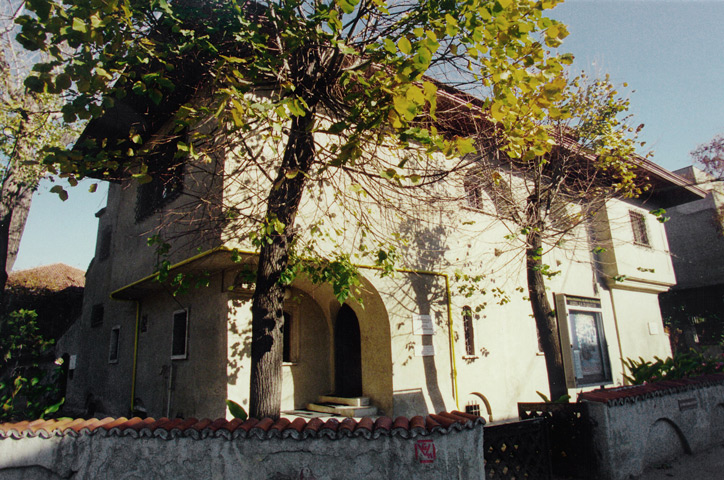
Art collector and critic Krikor H. Zambaccian (1889-1962) put together one of the richest and most valuable private collections in Romania. In the 1940s Zambaccian had the house purpose built so as to enable him to display the paintings, sculptures, prints and drawings and furniture he had acquired over more than half a century. Both the collection and the house were donated by him to the Romanian State in 1947.
In celebration of his deed, Zambaccian was made a member of the Romanian Academy.
The collector’s portfolio of Romanian artists offers a brief but dense overview of modern Romanian art, covering representative paintings by founding figures like Theodor Aman, Nicolae Grigorescu, Ioan Andreescu, classical modernists like Ștefan Luchian, Nicolae Tonitza, Theodor Pallady and Gheorghe Petrașcu, and post-war figurative painters like Corneliu Baba, Alexandru Phoebus and Horia Damian. Sculptures by Brâncuși, Milița Petrașcu, Oscar Han and Cornel Medrea reflect Zambaccian’s preference for a more traditional vein of modernism. To create a context for Romanian art and enhance his prestige, Zambaccian also acquired works by Cézanne, Picasso, Matisse, Bonnard, Utrillo, and Marquet, which lend his collection a profile unmatched in Romania.  

Facebook Page

Acest site folosește cookies

Folosim module cookie pentru a vă pune la dispoziție caracteristici de social media și pentru a analiza traficul. Navigând în continuare, vă exprimați acordul asupra folosirii acestora.