Accessibility Tools

Visiting hours:
The National Museum of Art of Romania
, the Theodor Pallady Museum and the K. H. Zambaccian Museum can be visited: Wednesday-Friday 10am-6pm
Saturday-Sunday 11am-7pm, Monday and Tuesday closed. Free entry on the first Wednesday of the month.
The Art Collections Museum: Monday, Tuesday and Friday, 10am-6pm, Saturday and Sunday 11am-7pm, closed Wednesday and Thursday. Free entry on the first Tuesday of the month.
Last entrance: 1 hour before closing for The National Museum of Art of Romania and the Art Collections Museum and 30 minutes for the Theodor Pallady Museum, the K. H. Zambaccian Museum and the temporary exhibitions.
For guided tours, please make a reservation at secretariat@art.museum.ro at least 7 days in advance.
For visits to our museum without guided tours there is no reservation necessary.

Starting with February 4, 2026, the Theodor Pallady Museum is temporarily closed for reorganization and renovation works.

The National Museum of Art of Romania
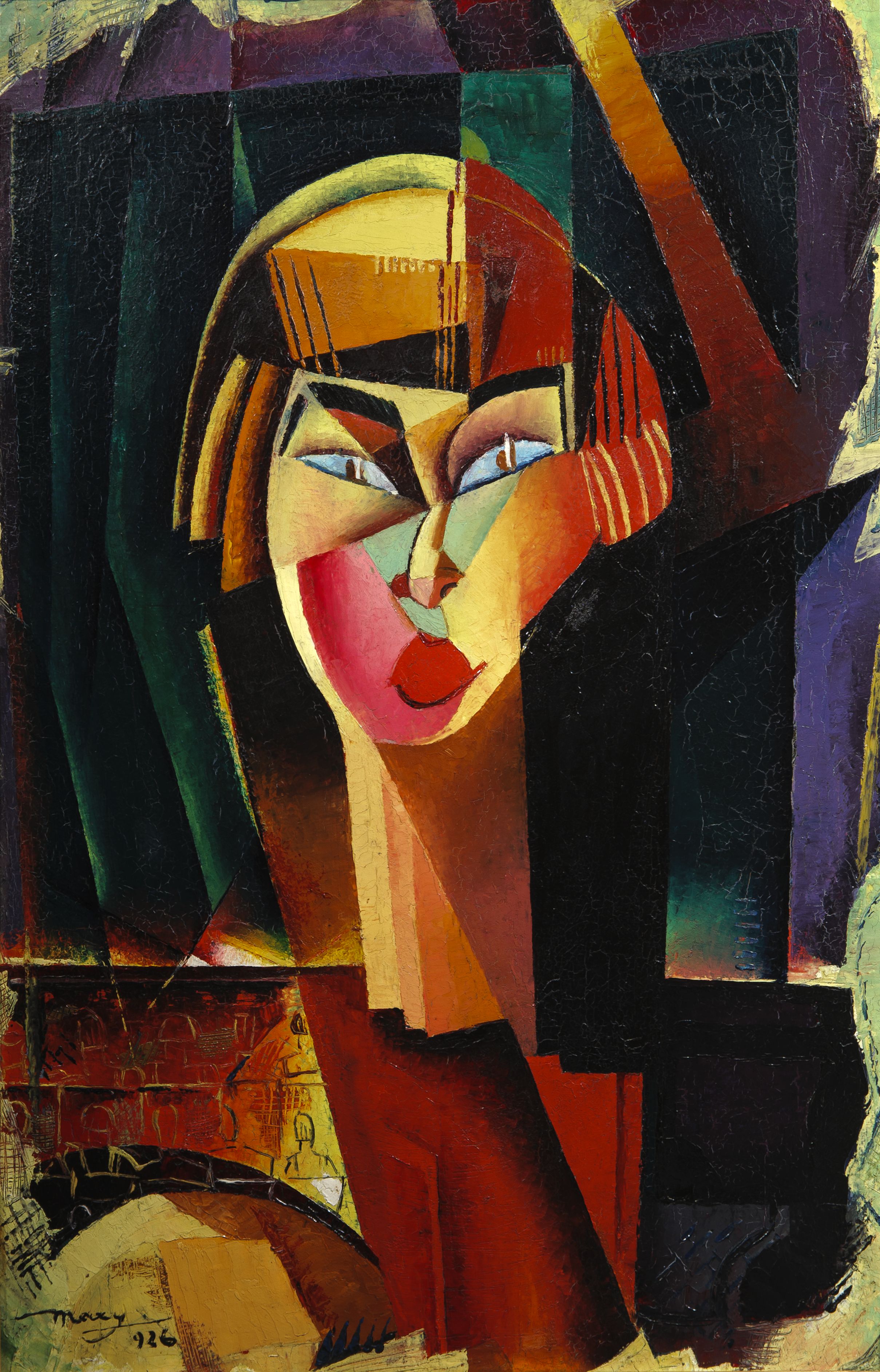
Maxy - Electric Madonna
Artwork description
Max Hermann Maxy
(Brăila, 1895 – Bucharest, 1971)
Oil on cardboard
70,5 x 46,5 cm
Inv. 8100
Artwork location
Romanian Modern Art Gallery , room 6
Sign language video
Sign language video

Maxy’s Electric Madonna is in fact a portrait of Florentina Ciricleanu, a young actress who, by the mid-1920s, used to attend avant-garde events organised by the Contimporanul magazine. This was most probably how she met artists such as Maxy, Miliţa Pătraşcu, Petre Iorgulescu Yor and Corneliu Michăilescu, for whom she sat as a model during the following decade. The painting is dated 1926, the year Florentina Ciricleanu played in a production staged by the National Theatre in Bucharest.

The picture is nothing short of a genuine geometrical puzzle. An electric colour range sets the painting along some of Maxy’s avant-garde paintings of the 1920s. One of the best known such portrait is that of Tristan Tzara, founding father of the Dada movement. Though to various degrees, both portraits reveal Maxy’s indebtedness to Cubism.

See more works in the Romanian Modern Art Gallery

VIRTUAL GALLERY OF ORIENTAL ART. COLLECTION OF ISLAMIC ART

VIRTUAL GALLERY OF ORIENTAL ART. COLLECTION OF ISLAMIC ART

The collection of Islamic art at the National Museum of Art in Romania is the most significant of its kind in Romania, comprising approximately 1,400 pieces dating from the 7th to the 20th century.

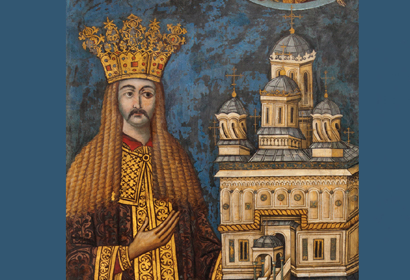
"Beyond the Legend: Neagoe Basarab"

Curators: Emanuela Cernea, Iuliana Dumitrașcu

K.H. Zambaccian Museum

K.H. Zambaccian Museum

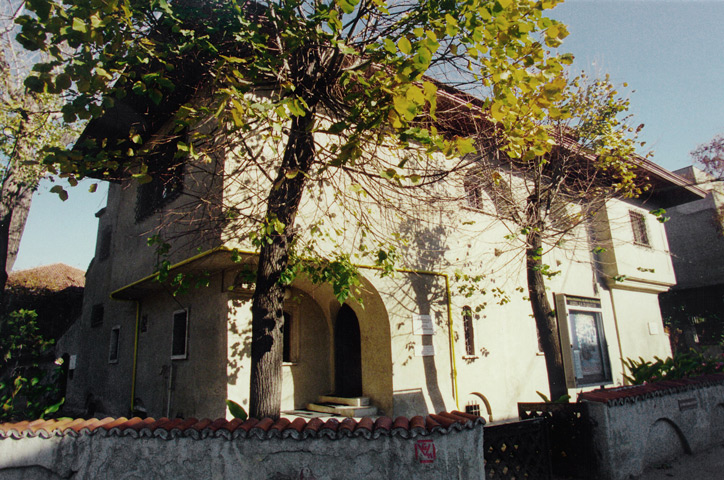
Art collector and critic Krikor H. Zambaccian (1889-1962) put together one of the richest and most valuable private collections in Romania. In the 1940s Zambaccian had the house purpose built so as to enable him to display the paintings, sculptures, prints and drawings and furniture he had acquired over more than half a century. Both the collection and the house were donated by him to the Romanian State in 1947.
In celebration of his deed, Zambaccian was made a member of the Romanian Academy.
The collector’s portfolio of Romanian artists offers a brief but dense overview of modern Romanian art, covering representative paintings by founding figures like Theodor Aman, Nicolae Grigorescu, Ioan Andreescu, classical modernists like Ștefan Luchian, Nicolae Tonitza, Theodor Pallady and Gheorghe Petrașcu, and post-war figurative painters like Corneliu Baba, Alexandru Phoebus and Horia Damian. Sculptures by Brâncuși, Milița Petrașcu, Oscar Han and Cornel Medrea reflect Zambaccian’s preference for a more traditional vein of modernism. To create a context for Romanian art and enhance his prestige, Zambaccian also acquired works by Cézanne, Picasso, Matisse, Bonnard, Utrillo, and Marquet, which lend his collection a profile unmatched in Romania.  

Facebook Page

Acest site folosește cookies

Folosim module cookie pentru a vă pune la dispoziție caracteristici de social media și pentru a analiza traficul. Navigând în continuare, vă exprimați acordul asupra folosirii acestora.