Accessibility Tools

Visiting hours:
The National Museum of Art of Romania
, the Theodor Pallady Museum and the K. H. Zambaccian Museum can be visited: Wednesday-Friday 10am-6pm
Saturday-Sunday 11am-7pm, Monday and Tuesday closed. Free entry on the first Wednesday of the month.
The Art Collections Museum: Monday, Tuesday and Friday, 10am-6pm, Saturday and Sunday 11am-7pm, closed Wednesday and Thursday. Free entry on the first Tuesday of the month.
Last entrance: 1 hour before closing for The National Museum of Art of Romania and the Art Collections Museum and 30 minutes for the Theodor Pallady Museum, the K. H. Zambaccian Museum and the temporary exhibitions.
For guided tours, please make a reservation at secretariat@art.museum.ro at least 7 days in advance.
For visits to our museum without guided tours there is no reservation necessary.

Starting with February 4, 2026, the Theodor Pallady Museum is temporarily closed for reorganization and renovation works.

The National Museum of Art of Romania
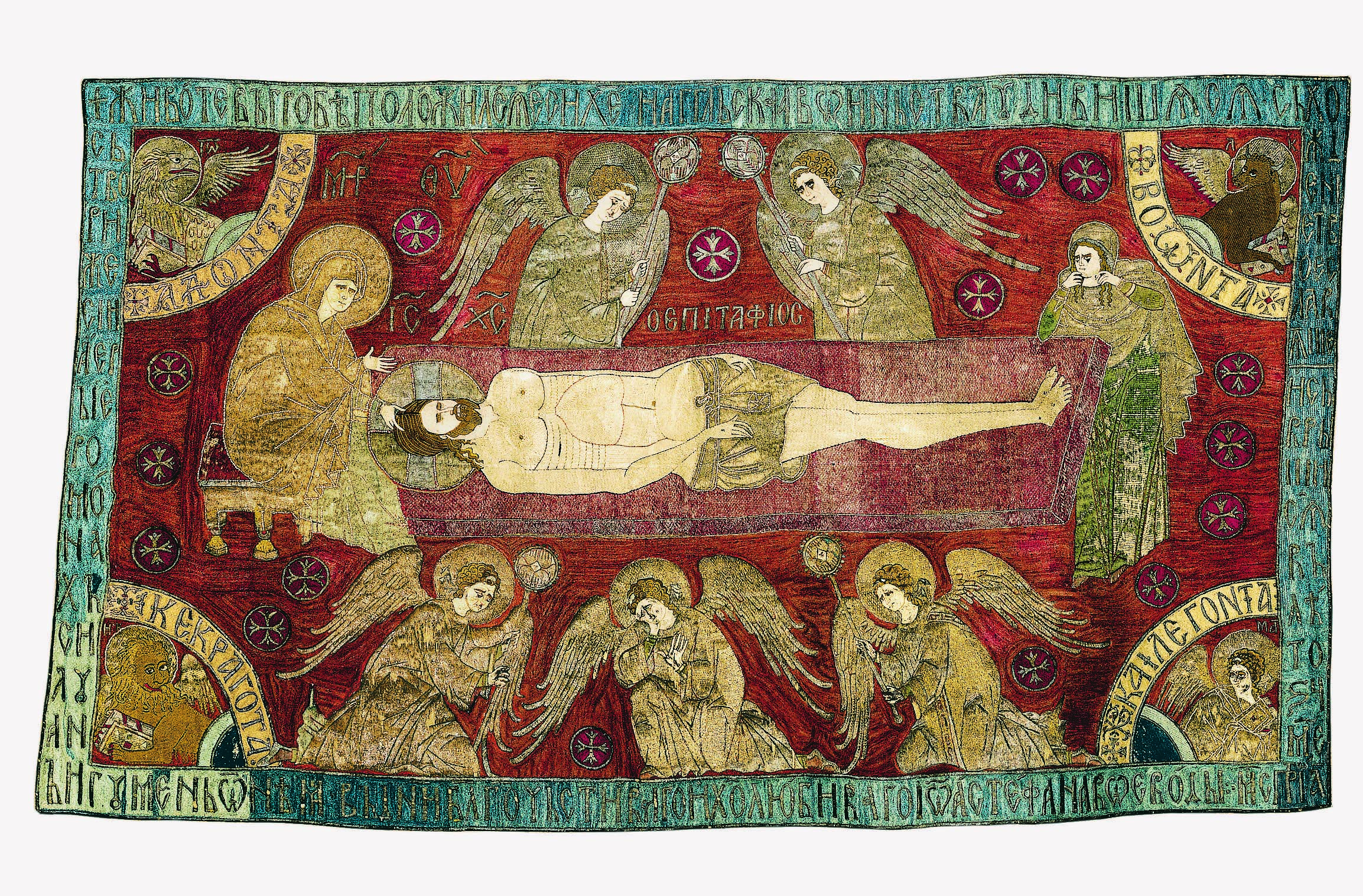
The Epitaphios of Silvan
Artwork description
Epitaphios
Embroidery, silver gilt thread
240 cm x 156 cm
Moldavia
1437
Inv. 15827 / B 182
Artwork location
Romanian Medieval Art Gallery, room 1
Sign language video
Sign language video

According to the inscription that surrounds the embroidery, this epitaphios bears the name of the abbot who donated it to the Neamţ monastery in 1437. Monks executed it in the workshop of the the Neamţ monastery, at that time an important and active cultural and artistic centre. They used the very best materials available: silk cloth, silver and gold threads, pearl beading for the most important contours.

The epitaphios, most often in the form of a large cloth, is basically an icon that depicts the Lamentation of Christ. The body of Jesus is lying on the red stone of Ephesus, surrounded by those who mourn Him: Virgin Mary seated by His head, Mary Magdalene literally tearing off her hair, and five angels. At the corners are the symbolic representations of the four Evangelists: the eagle (John), the ox (Luke), the lion (Mark), and the angel (Matthew). Monks used the cross-in-a-circle motif and the votive inscription that frames the central scene as both symbolic and decorative devices.

In Orthodox churches, the epitaphios is preserved in the altar and used during services on Good Friday and Holy Saturday. It is associated with the Descent from the Cross, the Lamentation and the Deposition.

The lengthy rule of Prince Alexandru I of Moldavia (1400-1432) enabled a number of local workshops to appropriate and develop the imperial Byzantine tradition at a time when Byzantium was under constant threat from the Ottoman Turks. Monks at the Neamț monastery genuinely mastered the craft of embroidery; their use of various needle points enabled them to create such spectacular effects as to render embroidery as suggestive as painting.


See more works in the Romanian Medieval Art Gallery
 

Romanian Modern Art Gallery

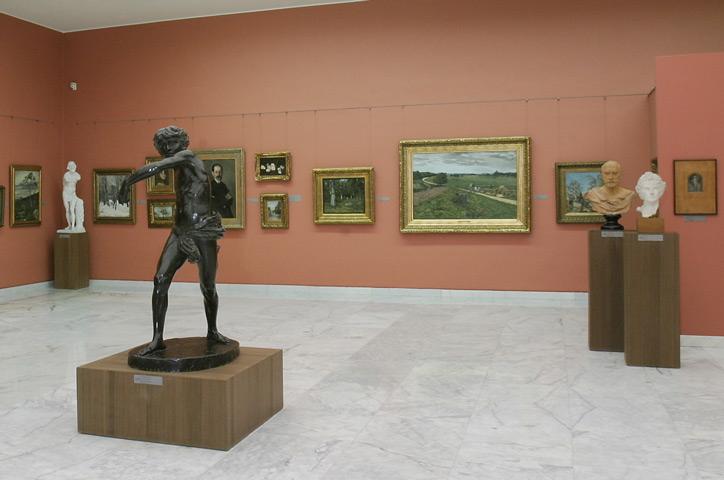
Romanian Modern Art Gallery

The Romanian Modern Art Gallery tells the story of Romanian art from the mid-nineteenth to the late twentieth century. Representative works by Theodor Aman, Nicolae Grigorescu, Ioan Andreescu, Theodor Pallady among others, illustrate connections with contemporary French painting while those of M.H. Maxy, Marcel Ianco, Victor Brauner trace the contribution of Romanian art to the European avant-garde of the 1920s and 1930s. Early sculptures by Brancusi reveal the master’s will to break away from academic tradition and find a way of his own. 

The exhibition

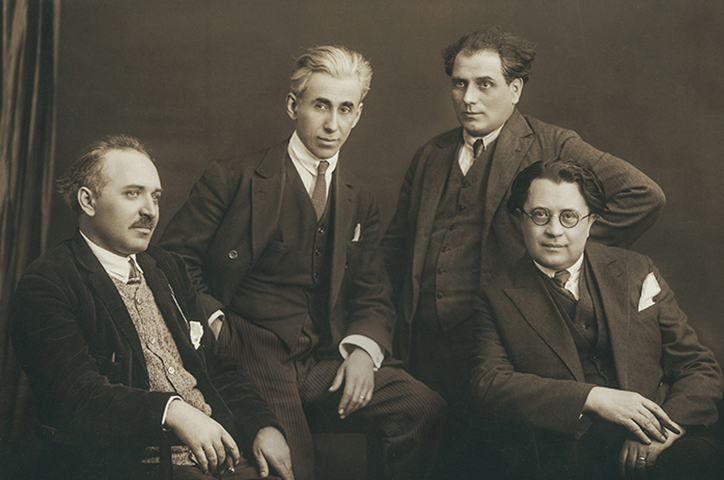
The exhibition "The Group of Four (1925 – 1934): Oscar Han, Ștefan Dimitrescu, Nicolae Tonitza and Francisc Șirato”

Exhibition organized by: Liliana Chiriac, Monica Croitoru-Tonciu, Ilinca Damian.

The Art Collections Museum

The Art Collections Museum

Inaugurated in 1978 as a Department of the National Museum of Art of Romania, the Art Collections Museum showcases artistic interests that prevailed in Romanian society from the early 20th century onward. Over 30 collections on permanent display incorporate a variety of art pieces and collectibles, ranging from Romanian and European fine and decorative arts to Oriental art. Donated over nearly a century by both collectors and artists, they bear witness to their owners’ taste and economic power, their leaning toward famous names or contemporary art, as well as to the artists’ particular interests, surroundings, and daily studio practice. Works by well-known Romanian painters such as Theodor Aman, Nicolae Grigorescu, Ioan Andreescu, Nicolae Tonitza, Gheorghe Petraşcu, Theodor Pallady, Lucian Grigorescu, Iosif Iser, Camil Ressu, Francisc Şirato, Alexandru Ciucurencu, Dimitrie Ghiaţă are exhibited alongside European and Japanese prints and drawings, French furniture, Oriental carpets, and folk icons from Transylvania. This unique museum is hosted by the former Romanit palace. The building, an example of modern Bucharest architecture, was recently restored and refurbished. Wherever possible, displays suggest the original layout and atmosphere of individual collections.

Facebook Page

Acest site folosește cookies

Folosim module cookie pentru a vă pune la dispoziție caracteristici de social media și pentru a analiza traficul. Navigând în continuare, vă exprimați acordul asupra folosirii acestora.