


Discover the works in the European Art Gallery
Brueghel - Flower Bouquet

The Bucharest panel represents Jan Brueghel the Elder’s biggest and most complex Flower Bouquet. The painting is conceived along the same lines as the panel made for Cardinal Federico Borromeo in 1606. Many contemporary collectors and art lovers ordered similar paintings, turning this new type of still-life into one of the most successful creations ever of Jan Brueghel’s studio. Several generations of painters active in his studio specialized in flower bouquets of every size and complexity.
This particular painting is a true visual enciclopaedia. It depicts dozens of flower and plant species and varieties which the artist had studied for months in the Brussels garden of Archduke Albrecht of Habsburg. Amidst this rich floral world hide around 20 insect species. Flowers blossom and fade away, catepillars turn into crysalids which turn into butterflies thus measuring the passage of time and suggesting life’s cycles. Upon contemplating the painting one becomes aware of the frailty and ephemeral nature of beauty and life as much as of the divine nature of art. Close to the vase rim a fly’s buzz breaks the silence and our pensive contemplation…
Read more: Brueghel - Flower Bouquet
- Artwork description
- Jan Brueghel the Elder
(Bruxelles, 1568 - Antwerp, 1625)
Flemish school
Oil on wood
162 x 132 cm
Inv. 7988/22 - Artwork location
- European Art Gallery, 2nd floor, room 8
- Sign language video
- Sign language video
Hemessen - The Calling of Saint Matthew
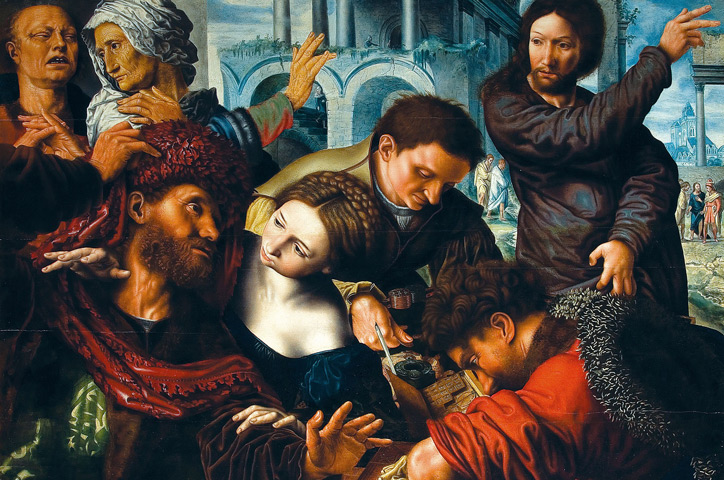
In The Calling of Saint Matthew by Netherlandish painter Jan Sanders van Hemessen shows the moment Jesus imperatively calls Matthew to follow Him. As a result, the tax collector in Capernaum turns into one of the twelve apostles and author of the first Gospel.
Matthew sits in the corner opposite to Jesus. He wears a rich robe and a fancy headdress in fashion a hundred years earlier. By the mid-16th century this strange turban was specifically associated with moneylenders and bankers. The two young men busy counting money and filling in ledgers are totally unaware of the momentous event that goes on right under their eyes: in answer to Jesus’s call, Matthew removes his headdress, ready to give up all worldly possessions. While this foreground scene reflects contemporary life in Antwerp (some identified Matthew with the Holy Roman Emperor Charles V), the Classical buildings behind speak of a Biblical time. Such blending in of the contemporary and the Biblical is suggestive of history repeating itself. By the middle of the 16th century Antwerp, a turning point in world trade, was relying heavily on the fortunes of merchants and bankers. Could this be what the two characters behind Matthew are discussing so vividly?
Read more: Hemessen - The Calling of Saint Matthew
- Artwork description
- Jan Sanders van Hemessen
(Hemiksem, c. 1500 - ? c. 1575/1579)
Netherlandish school
Oil on wood
111 x 140,7 cm
Inv. 8096/130 - Artwork location
- European Art Gallery, 2nd floor, room 6
Guercino - Saint Benedict and Saint Francis Listening to a Musician Angel
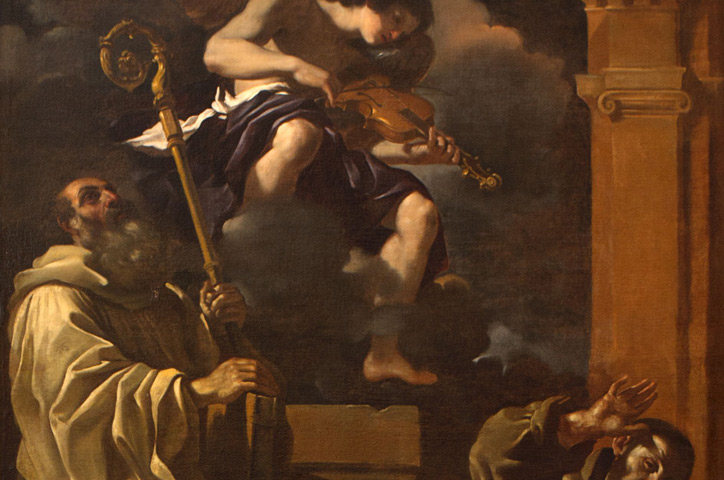
This is one of Guercino’s most profoundly Baroque paintings: the spectacular, highly dramatic movement is supported by the rhomboid composition scheme, the bold foreshortenings and the spiral movement of the bodies.
The painting brings together Saint Benedict and Saint Francis, two of the most important organisers of Western European monasticism.
Guercino features the two saints listening in awe to an angel playing the violin, thereby suggesting that, though seven hundred years apart, both monastic orders were of divine inspiration. In the early 17th century violin was hardly if ever associated with church music. However, it is possible that to those who ordered the painting for the Dondini chapel of the San Pietro church in Cento, the angel playing the violin held special significance.
Read more: Guercino - Saint Benedict and Saint Francis Listening to a Musician Angel
- Artwork description
- Giovanni Francesco Barbieri called Il Guercino
(Cento, 1591- Bologna, 1666)
Italian school
Oil on canvas
263 x 184 cm
Inv. 8059/93 - Artwork location
- European Art Gallery, 1st floor, room 3
El Greco - The Adoration of the Shepherds
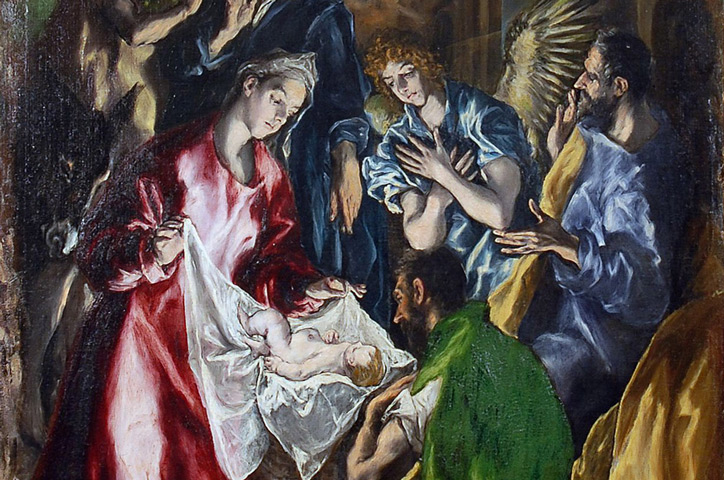
The Adoration of the Shepherds was part of the high altar of the Dona María de Aragón colegiate church in Madrid on which El Greco had worked between 1596 and 1600. The artist had conceived a monumental structure consisting of 6 paintings and 6 sculptures which visually embodied the idea of the Incarnation of the Son of God, the subject of many theological debates in contemporary Spain. The altar was dismantled in the early 19th century, the other five paintings being now with the Prado Museum.
The Adoration of the Shepherds The scene is set at night. The lower part of the painting features the secular while the upper half represents the Divine world, angels singing songs of praise to the Lord. El Greco focuses on the moment when shepherds kneal in front of the infant Jesus, venerating Him. The white lamb, the gift they brought Him, foretells Christ’s sacrifice.
Read more: El Greco - The Adoration of the Shepherds
- Artwork description
- Doménikos Theotokópoulos, called El Greco
(Crete, 1541 - Toledo, 1614)
Spanish school
Oil on canvas
364 x 137 cm
Inv. 8423/457 - Artwork location
- European Art Gallery, 2nd floor, room 5
- Sign language video
- Sign language video
Cranach - Venus and Cupid
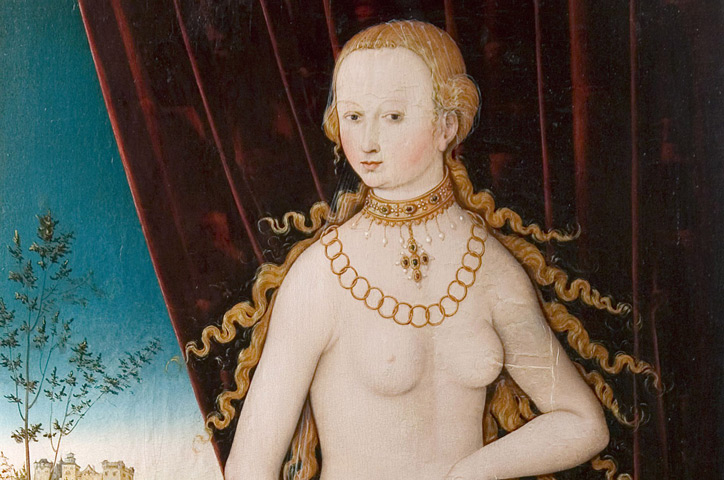
Lucas Cranach the Elder painted at least fifteen versions of the theme, each of them slightly different from the other. The Bucharest painting is signed and dated 1520, being one of the earlier versions. Peaceful and perfectly balanced in her posture, Venus seems to discreetly argue that the relationship between Christian virtue and wordly love needs not neccesarily be a tensioned or guilty one. Or else why would the goddess of love wear a cross around her neck?
Venus stands in front of us in an elegant contraposto, her right leg perpendicular onto her left leg, a posture typical of so many of Cranach’s female characters. She wears nothing but a thin, transparent, almost invisible veil which descends from the top of her head to her hips. In the late 18th or early 19th century the painting’s owner must have considered her nudity offensive so he had her covered in a dark blue veil. The latter was removed during restoration in the late 1990s, leaving Venus no more provocative than Eve before her banishment from Paradise.
The winged Cupid stands to the left of Venus, supporting the bow with his right arm and foot. He mischeviously hides the arrow of love from his mother’s sight, but not from ours, thus making us wander: will he use it onto Venus or not?
Read more: Cranach - Venus and Cupid
- Artwork description
- Lucas Cranach the Elder
(Kronach, 1472 - Weimar, 1553)
German school
Oil on wood
104 x 57 cm
Inv. 8107/141 - Artwork location
- European Art Gallery, 1st floor, room 4
Bramantino - Pietà
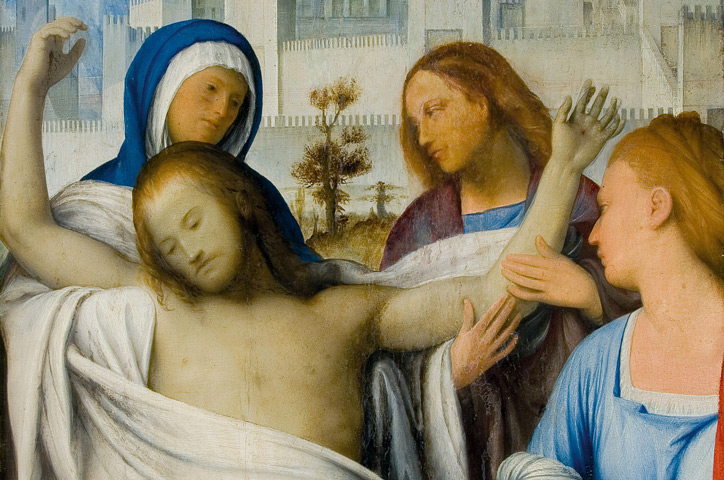
Bramantino painted this altar piece sometime around 1512-1515, at the height of his career. The scene is set just outside the walls of city whose buildings are clearly visible. This is perhaps one of the most beautiful and comprehensive cityscape ever imagined by Bramantino. The artist seems to imply the ideal city is a most befitting backdrop for the Pietà, suggestive of the Redeemer’s incorruptible perfection.
Note the surreal, otherwordly quality of the painting in which Christ’s Lamentation and the architectural vista share the picture plane in almost equal proportions.
It was approximately at the same time that Lady Despina, wife of Wallachian ruler Neagoe Basarab, ordered a small icon representing the Descent from the Cross, a theme close to the Lamentation. Though different in both scale and approach, both paintings are highly original and prompt us to pause to understand the manner in which Western Catholic and Eastern Orthodox artists visually illustrate contemporary ideas.
- Artwork description
- Bartolomeo Suardi
(Bergamo, c. 1465 – Milan, 1530)
Italian school
Oil on wood
102 x 80 cm
Inv. 7988/22 - Artwork location
- European Art Gallery, 1st floor, room 1


